ثبت نام / ورود
0
ثبت نام / ورود
0
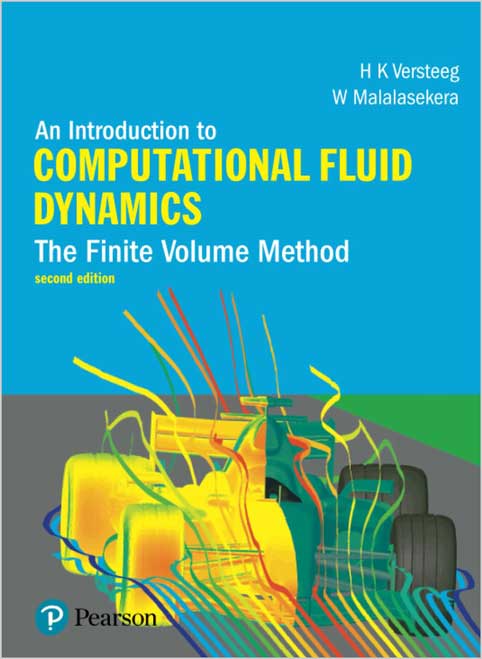
H K Versteeg, W Malalasekera
#Computational_Fluid_Dynamics
#CFD
#LES
#CFX
The use of Computational Fluid Dynamics to simulate and predict fluid flows, heat transfer and associated phenomena continues to grow throughout many engineering disciplines. On the back of ever more powerful computers and graphical user interfaces CFD provides engineers with a reliable tool to assist in the design of industrial equipment often reducing or eliminating the need for performing trial-and-error experimentation.
An Introduction to Computational Fluid Dynamics is the ideal text for the newcomer to the area whether they be undergraduates, graduates, or professionals. It provides thorough yet accessible coverage of commercial finite volume based CFD codes within the context of the underlying theory, giving the reader a full appreciation of CFD and its numerous engineering applications.
Key features
New to this edition
Table of Contents
1 Introduction
2 Conservation laws of fluid motion and boundary conditions
3 Turbulence and its modelling
4 The finite volume method for diffusion problems
5 The finite volume method for convection---diffusion problems
6 Solution algorithms for pressure---velocity coupling in steady flows
7 Solution of discretised equations
8 The finite volume method for unsteady flows
9 Implementation of boundary conditions
10 Errors and uncertainty in CFD modelling
11 Methods for dealing with complex geometries
12 CFD modelling of combustion
13 Numerical calculation of radiative heat transfer
Appendix A Accuracy of a flow simulation
Appendix B Non-uniform grids
Appendix C Calculation of source terms
Appendix D Limiter functions used in Chapter 5
Appendix E Derivation of one-dimensional governing equations for steady, incompressible flow through a planar nozzle
Appendix F Alternative derivation for the term (n . grad φAi) in Chapter 11
Appendix G Some examples
About the Authors
H K Versteeg and W Malalasekera are both senior lecturers in Thermo-Fluids, at Loughborough University.