ثبت نام / ورود
0
ثبت نام / ورود
0
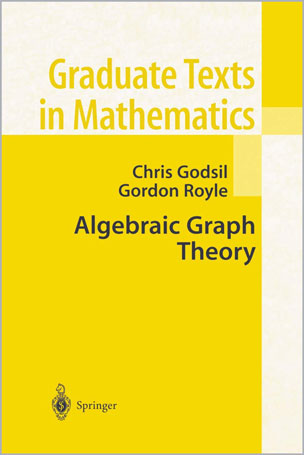
Chris Godsil, Gordon Royle
#Graph_Theory
#Algebraic
#Moore_Graphs
#Regular_Graphs
#Eulerian_Cycles
#Knots
Algebraic graph theory is a combination of two strands. The first is the study of algebraic objects associated with graphs. The second is the use of tools from algebra to derive properties of graphs. The authors's goal has been to present and illustrate the main tools and ideas of algebraic graph theory, with an emphasis on current rather then classical topics. While placing a strong emphasis on concrete examples they tried to keep the treatment self-contained.
1 Graphs
2 Groups
3 Transitive Graphs
4 Arc-Transitive Graphs
5 Generalized Polygons and Moore Graphs
6 Homomorphisms
7 Kneser Graphs
8 Matrix Theory
9 Inter lacing
10 Strongly Regular Graphs
11 Two-Graphs
12 Line Graphs and Eigenvalues
13 The Laplacian of a Graph
14 Cuts and Flows
15 The Rank Polynomial
16 Knots
17 Knots and Eulerian Cycles
C. Godsil and G.F. Royle
Algebraic Graph Theory
"A welcome addition to the literature . . . beautifully written and wide-ranging in its coverage."―MATHEMATICAL REVIEWS
"An accessible introduction to the research literature and to important open questions in modern algebraic graph theory"―L'ENSEIGNEMENT MATHEMATIQUE