ثبت نام / ورود
0
ثبت نام / ورود
0
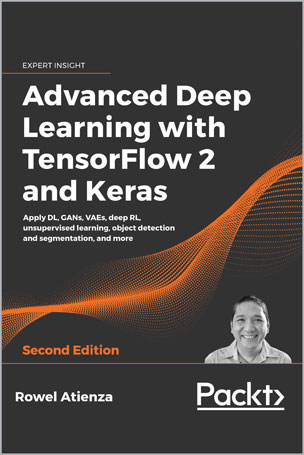
Apply DL, GANs, VAEs, deep RL, unsupervised learning, object detection and segmentation, and more
Rowel Atienza
#Deep_Learning
#TensorFlow2
#Keras
#DL
#GAN
#VAE
#AI
#DenseNet
#MLPss
#CNN
#RNN
Updated and revised second edition of the bestselling guide to advanced deep learning with TensorFlow 2 and Keras
Advanced Deep Learning with TensorFlow 2 and Keras, Second Edition is a completely updated edition of the bestselling guide to the advanced deep learning techniques available today. Revised for TensorFlow 2.x, this edition introduces you to the practical side of deep learning with new chapters on unsupervised learning using mutual information, object detection (SSD), and semantic segmentation (FCN and PSPNet), further allowing you to create your own cutting-edge AI projects.
Using Keras as an open-source deep learning library, the book features hands-on projects that show you how to create more effective AI with the most up-to-date techniques.
Starting with an overview of multi-layer perceptrons (MLPs), convolutional neural networks (CNNs), and recurrent neural networks (RNNs), the book then introduces more cutting-edge techniques as you explore deep neural network architectures, including ResNet and DenseNet, and how to create autoencoders. You will then learn about GANs, and how they can unlock new levels of AI performance.
Next, you'll discover how a variational autoencoder (VAE) is implemented, and how GANs and VAEs have the generative power to synthesize data that can be extremely convincing to humans. You'll also learn to implement DRL such as Deep Q-Learning and Policy Gradient Methods, which are critical to many modern results in AI.
This is not an introductory book, so fluency with Python is required. The reader should also be familiar with some machine learning approaches, and practical experience with DL will also be helpful. Knowledge of Keras or TensorFlow 2.0 is not required but is recommended.
About the author
Rowel Atienza is an Associate Professor at the Electrical and Electronics Engineering Institute of the University of the Philippines. He has been fascinated by intelligent robots since he was young. In his MEng at the National University of Singapore, he formulated a control algorithm to enable a four-legged robot walk. In his PhD at the Australian National University, he built the first active gaze tracking system for natural human-robot interaction. Rowel likes teaching and research on computer vision and deep learning. He is a recipient of both government and private research funds.