ثبت نام / ورود
0
ثبت نام / ورود
0
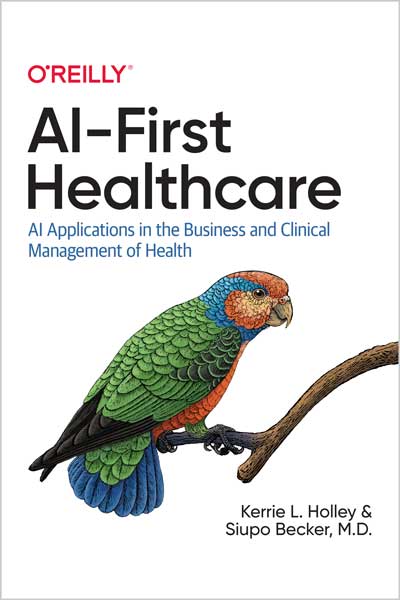
AI Applications in the Business and Clinical Management of Health
Kerrie L. Holley, Siupo Becker, M.D.
#AI
#Healthcare
#Clinical_Management
#Health
AI is poised to transform every aspect of healthcare, including the way we manage personal health, from customer experience and clinical care to healthcare cost reductions. This practical book is one of the first to describe present and future use cases where AI can help solve pernicious healthcare problems.
Kerrie Holley and Siupo Becker provide guidance to help informatics and healthcare leadership create AI strategy and implementation plans for healthcare. With this book, business stakeholders and practitioners will be able to build knowledge, a roadmap, and the confidence to support AI in their organizations―without getting into the weeds of algorithms or open source frameworks.
Cowritten by an AI technologist and a medical doctor who leverages AI to solve healthcare’s most difficult challenges, this book covers:
The number of books describing artificial intelligence (AI), machine learning, deep learning, natural language processing, and the full constellation of AI technologies could fill a library. Coupled with the ever-growing list of articles, videos, and blogs, there is no lack of content. Clinicians, computer scientists, technologists, physicians, philosophers, and journalists each tackle different AI issues and challenges.
However, we couldn’t find a book that discussed AI from a medical doctor and a technologist’s paired perspectives. This is a book that tracks the journey of a physician and a technologist working together, discussing AI’s opportunity while explaining AI for the consumption of a clinician, an IT worker, a user, an executive, or a business stakeholder. Our goal is for you to understand the possibilities for improvements in healthcare supercharged by artificial intelligence.
While discussing this vast potential, we strove to maintain the awe of AI while grounding the reader in the reality of AI today. We hope that Chapter 1 will provide you with confidence that you understand the myth versus the reality. More importantly, this first chapter seeks to familiarize you with the language of AI—what is a model, an algorithm, a neural network, and more—without your needing to brush up on linear algebra or computer science.
Chapter 2 integrates human-centered design, with providers and technologists working together to build smart systems to ensure that AI is used to do good. Chapter 3 helps the reader see how combining AI with sensing and monitoring, given the growth of intelligent objects, affords unparalleled opportunity for accelerating personalized medicine. Chapter 4 describes digital transformation and AI, and the utility of AI for digital transformation.
Several opportunities exist for using AI to reduce the amount of waste in healthcare and to reduce medical errors, as addressed in Chapter 5. Chapter 6 describes several AI solutions that, when realized, materially affect the quadruple aim of healthcare. Last, Chapter 7 provides a road map for how organizations realize AI’s benefits not just for a single instance but at scale.
The state of healthcare is top of mind because it touches most aspects of our lives. The recent pandemic exposes the slow train wreck of dumb systems frustrating doctors, provider systems, and patients. There is no “silver bullet,” no quick fix, no one-size-fits-all solution, but the potential to transform healthcare with AI is now possible. We hope this book provides a blueprint for organizations in their journey to leverage AI to make healthcare better for everyone.
Kerrie Holley is a former IBM Fellow and joined Optum as their first Technology Fellow focused on advancing healthcare with technology. He holds a number of technology patents and is author of two previous books.
Dr. Siupo Becker's clinical background is in internal medicine and infectious diseases. She practiced for over 14 years and is now a senior healthcare executive. Her experience includes providing top Fortune 50 companies with innovative approaches to their healthcare needs. Her skill sets include work in population health management, case management, client retention and growth, and technology solutions and digital health innovation as well as product development.