ثبت نام / ورود
0
ثبت نام / ورود
0
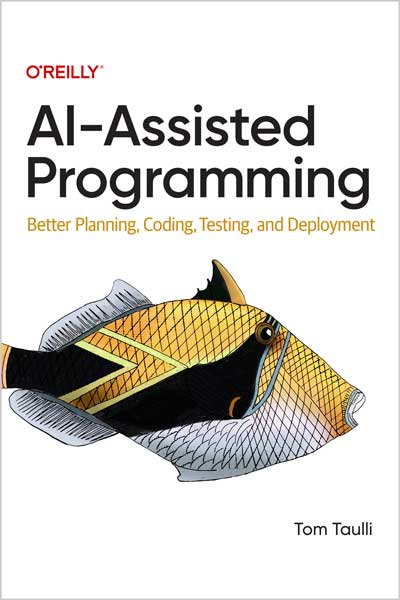
Better Planning, Coding, Testing, and Deployment
Tom Taulli
#AI-Assisted
#LLMs
#ChatGPT
#Gemini
#Claude
#GitHub
#Copilot
#CodeWhisperer
#Amazon
Get practical advice on how to leverage AI development tools for all stages of code creation, including requirements, planning, design, coding, debugging, testing, and documentation. With this book, beginners and experienced developers alike will learn how to use a wide range of tools, from general-purpose LLMs (ChatGPT, Gemini, and Claude) to code-specific systems (GitHub Copilot, Tabnine, Cursor, and Amazon CodeWhisperer).
You'll also learn about more specialized generative AI tools for tasks such as text-to-image creation.
Author Tom Taulli provides a methodology for modular programming that aligns effectively with the way prompts create AI-generated code. This guide also describes the best ways of using general purpose LLMs to learn a programming language, explain code, or convert code from one language to another.
This book examines:
Table of Contents
Chapter 1. New World for Developers
Chapter 2. How Al Coding Technology Works
Chapter 3. Prompt Engineering
Chapter 4. GitHub Copilot
Chapter 5. Other Al-Assisted Programming Tools
Chapter 6. ChatGPT and Other General-Purpose LLMs
Chapter 7. Ideas, Planning, and Requirements
Chapter 8. Coding
Chapter 9. Debugging, Testing, and Deployment
Chapter 10. Takeaways
How This Book Is Different
Software developers thrive on certainty. When you give a program certain input, you always get the same output. For ages, this pure deterministic logic was the heart and soul of software.
But when you use AI-assisted programming tools, things get a bit topsy-turvy. Getting results is like rolling dice since everything works on probabilities. When you prompt an AI tool to whip up some code, and even use the same prompt over multiple tries, you might get different results each time. Sure, it’s a bit of a head-scratcher at first, but once you get the hang of it, it’s totally worth it. That’s why there is a chapter on prompt engineering that will help with this new approach to programming.
Who Should Read This Book
This book is for any developer, whether you’re just starting out or you’ve been in the game for many years.
"When we added vector search to Cassandra in 6 weeks, Copilot and ChatGPT were key to meeting our deadline, but most developers have yet to take advantage of AI tools like these. Tom's book is a great way to get started and will save you hours of trial and error." (Jonathan Ellis, co-founder and CTO of DataStax)
"AI-Assisted Programming is an excellent resource that showcases Tom's expertise and equips readers for the current evolution of software development, empowering everyone to code." (Justin Dorfman, Open Source Community Manager at Sourcegraph)
"AI is rapidly changing how developers build software. From code editors to terminal and more, AI assistance is becoming pervasive. AI-assisted Programming should be the first read for any developer trying to get the most from AI in their daily workflows." (Zach Lloyd, CEO and cofounder of Warp)
"Tom Taulli's AI-assisted programming guide is a well-structured journey into how AI tools like ChatGPT can change the game for developers - both early in their careers and for seasoned experts. It shares applicable insights on the ups and downs of AI-powered coding, much like my own journey from marketing and business to shipping features in production for our app. Great for programmers looking to leverage AI as part of their toolbox." (Titus Capilnean, cofounder at Private Market Labs)
"AI has changed the game for development. Every programmer will need to know how to work with tools like GitHub Copilot. Tom's book shows how." (Sudhakar Muddu, CEO and cofounder of Aisera)
Tom Taulli is a consultant to various companies, such as Aisera, a venture-backed generative AI startup. He has written several books like AI Basics and Generative AI, which cover ChatGPT, GPT-4 and other large-language models (LLMs). Tom has also taught IT courses for O'Reilly, UCLA and PluralSight. For these, he has provided lessons in using Python to create deep learning and machine learning models. He has also taught on topics like NLP (Natural Language Processing).