ثبت نام / ورود
0
ثبت نام / ورود
0
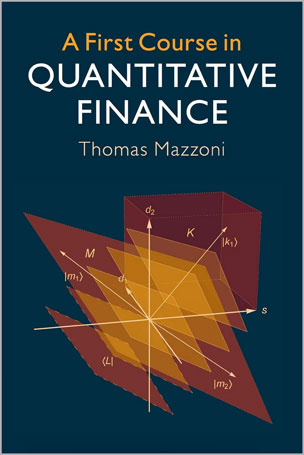
Thomas Mazzoni
#Quantitative
#Finance
#CAPM
#APT
#LIBOR
#Financial_Markets
#Econcomics
Table of Contents
1 Introduction
Part I Technical Basics
2 A Primer on Probability
3 Vector Spaces
4 Utility Theory
Part II Financial Markets and Portfolio Theory
5 Architecture of Financial Markets
6 Modern Portfolio Theory
7 CAPM and APT
8 Portfolio Performance and Management
9 Financial Econcomics
10 Behavioral Finance
Part III Derivatives
11 Forwards, Futures, and Options
12 The Binomial Model
13 The Black- Scholes-Theory
14 Exotics in the Black- Scholes-Model
15 Deterministic Volatility
16 Stochastic Volatility
17 Processes with Jumps
Part IV The Fixed-Income World
19 Plain Vanilla Fixed-Income Derivatives
20 Term Structure Models
21 The LIBOR Market Model
A Complex Analysis
B Solutions to Problems
Review
'A First Course in Quantitative Finance is a gentle introduction in a complicated subject. It covers most important topics - such as portfolio optimisation, derivative pricing, and fixed income products - and discusses them from the perspective of financial economics and financial mathematics. It provides the necessary mathematical background, contains the financial discussion, and is full of illustrative examples. It will be useful for anyone who wants to study the subject area on an advanced level.' Rüdiger Kiesel, Universität Duisburg-Essen
'This is a remarkably complete book on all aspects of modern finance, covering topics from the puzzles of financial economics, through modern portfolio management to the pricing of exotic options under stochastic volatility at an equally accessible yet state-of-the-art level. Quants, portfolio managers, students and teachers of finance alike will find it to be an invaluable source of insights and a must-have reference to have on their desks.' Peter Tankov, École nationale de la statistique et de l'administration économique
Using stereoscopic images and other novel pedagogical features, this book offers a comprehensive introduction to quantitative finance.
Thomas Mazzoni has lectured at the University of Hagen and the Dortmund Business School and is now based at the Universität Greifswald, Germany, where he received the 2014 award for excellence in teaching and outstanding dedication.