ثبت نام / ورود
0
ثبت نام / ورود
0
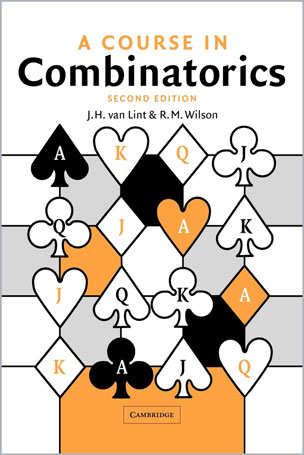
J. H. van Lint, R. M. Wilson
#Combinatorics
#Geometry
#Algebra
#Analysis
Combinatorics, a subject dealing with ways of arranging and distributing objects, involves ideas from geometry, algebra, and analysis. The breadth of the theory is matched by that of its applications, which include topics as diverse as codes, circuit design and algorithm complexity. It has thus become an essential tool in many scientific fields. In this second edition the authors have made the text as comprehensive as possible, dealing in a unified manner with such topics as graph theory, extremal problems, designs, colorings, and codes. The depth and breadth of the coverage make the book a unique guide to the whole of the subject. It is ideal for courses on combinatorical mathematics at the advanced undergraduate or beginning graduate level, and working mathematicians and scientists will also find it a valuable introduction and reference.
Table of Contents
1 Graphs
2 Trees
3 Colorings of graphs and Ramsey's theorem
4 Turan's theorem and extremal graphs
5 Systems of distinct representatives
6 Dilworth's theorem and extremal set theory
7 Flows in networks
8 De Bruijn sequences
9 Two (0,1,*) problems: addressing for graphs and a hash-coding scheme
10 The principle of inclusion and exclusion; inversion formulae
11 Permanents
12 The Van der Waerden conjecture
13 Elementary counting; Stirling numbers
14 Recursions and generating functions
15 Partitions
16 (0, 1 )-Matrices
17 Latin squares
18 Hadamard matrices, Reed- Muller codes
19 Designs
20 Codes and designs
21 Strongly regular graphs and partial geometries
22 Orthogonal Latin squares
23 Projective and combinatorial geometries
24 Gaussian numbers and q-analogues
25 Lattices and Mobius inversion
26 Combinatorial designs and projective geometries
27 Diffierence sets and automorphisms
28 Diffierence sets and the group ring
29 Codes and symmetric designs
30 Association schemes
31 (More) algebraic techniques in graph theory
32 Graph connectivity
33 Planarity and coloring
34 Whitney duality
35 Embeddings of graphs on surfaces
36 Electrical networks and squared squares
37 P6lya theory of counting
38 Baranyai's theorem
Appendix 1 Hints and comments on problems
Appendix 2 Formal power series
About the Authors
Jacobus Hendricus van Lint was a Dutch mathematician, professor at the Eindhoven University of Technology, of which he was rector magnificus from 1991 till 1996. He gained his Ph.D. from Utrecht University in 1957 under the supervision of Fred van der Blij.
Richard Michael Wilson is a mathematician and a professor emeritus at the California Institute of Technology. Wilson and his PhD supervisor Dijen K. Ray-Chaudhuri, solved Kirkman's schoolgirl problem in 1968. Wilson is known for his work in combinatorial mathematics, as well as on historical flutes.