ثبت نام / ورود
0
ثبت نام / ورود
0
José Antonio Oller
#nuclear
#nuclear_matter
#Dispersion_Relations
📖 این متن معرفی کوتاهی از رابطههای پاشندگی (Dispersion Relations) بهعنوان رویکردی برای محاسبهٔ عناصر ماتریس S ارائه میدهد؛ صورتبندیای که امکان بهرهگیری از ساختار تحلیلی دامنههای پراکندگی را بر پایهٔ اصول بنیادی یگانگی (Unitarity) و علیت (Causality) فراهم میکند.
⚛️ ابتدا حالت پراکندگی دوجسمی بررسی میشود و سپس نقش آن در سایر فرایندها از طریق برهمکنشهای حالت نهایی (Final-State Interactions) مورد بحث قرار میگیرد. برای دامنههای پراکندگی دوجسمی، رابطهٔ عمومی برای دامنهٔ موج جزئی (Partial-Wave Amplitude) در تقریبی که دینامیک کانالِ تبادلی (Crossed Channel) نادیده گرفته شده است، استخراج میشود. این نقطهٔ شروعی برای کاربردهای غیرپرتورباتیو جالب، چه در بخش کوارکهای سبک و چه در بخش کوارکهای سنگین است. سپس دینامیک کانال تبادلی درون معادلات محاسبهٔ دامنههای موج جزئی وارد میشود و همچنین کاربردهایی بر پایهٔ روشهایی که این دینامیک را بهطور پرتورباتیو در نظر میگیرند، بررسی میگردد.
🔬 بخش پایانی این مرور مقدماتی به تأثیرات بیشتر دامنههای پراکندگی بر فرآیندهای متنوع از طریق برهمکنشهای حالت نهایی اختصاص دارد. چندین رویکرد ممکن مطرح میشود، از جمله معادلات انتگرالی پاشندی موسخهلیشویلی–اومنِس (Muskhelishvili-Omnès) و فرمولهای بستهٔ دیگر. این صورتبندیهای متفاوت سپس بهطور ویژه برای مطالعهٔ رزونانسها که دارای ویژگیهای چالشبرانگیزی هستند، بهکار گرفته میشوند. کتاب در نهایت با فصلی به پایان میرسد که در آن استفاده از رابطههای پاشندگی در محیط هستهای برای محاسبهٔ چگالی انرژی در مادهٔ هستهای نشان داده میشود.
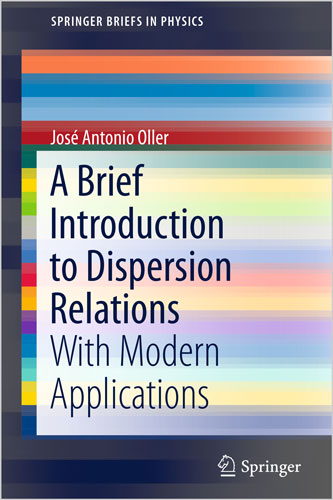
This text offers a brief introduction to the dispersion relations as an approach to calculate S-matrix elements, a formalism that allows one to take advantage of the analytical structure of scattering amplitudes following the basic principles of unitarity and causality.
First, the case of two-body scattering is considered and then its contribution to other processes through final-state interactions is discussed. For two-body scattering amplitudes, the general expression for a partial-wave amplitude is derived in the approximation where the crossed channel dynamics is neglected. This is taken as the starting point for many interesting nonperturbative applications, both in the light and heavy quark sector. Subsequently crossed channel dynamics is introduced within the equations for calculating the partial-wave amplitudes. Some applications based on methods that treat crossed-channel dynamics perturbatively are discussed too.
The last part of this introductory treatment is dedicated to the further impact of scattering amplitudes on a variety of processes through final-state interactions. Several possible approaches are discussed such as the Muskhelishvili-Omnes dispersive integral equations and other closed formulae. These different formalisms are then applied in particular to the study of resonances presenting a number of challenging properties. The book ends with a chapter illustrating the use of dispersion relations in the nuclear medium for the evaluation of the energy density in nuclear matter.
Table of Contents
1. S and T Matrices. Unitarity
2. Two-Body Scattering. Partial-Wave Expansion
3. Crossing. Crossed-Channel Singularities
4. Important Mathematical Results: Schwarz Reflection Principle, Sugawara–Kanazawa Theorem, and Herglotz Theorem
5. Exact Dispersion Relations in Quantum Mechanics for the Eigenvalues of the Scattering Kernel
6. General Results for Two-Meson Scattering in Partial Waves After Neglecting the Crossed-Channel Cuts. N/D Method
7. Reaching the Unphysical Riemann Sheets. A Nonlinear Integral Equation to Calculate a PWA
8. The Good (σ), The Bad (ρ) and the Difficult (LHC)
9. SU(3) Analysis of the Subtraction Constants in gi(s)
10. Perturbative Introduction of Crossed-Channel Cut Singularities
11. The N/D Method with Perturbative Δ(p2)
12. The First-Iterated N/D Solution with Perturbative Δ(p2)
13. Final(Initial)-State Interactions. Unitarity and Analyticity Requirements. Watson Final-State Theorem
14. The Omnès Solution. Reasoned Warnings on the Use of the Omnès Function
15. The Muskhelishvili-Omnès Problem in Coupled-Channel Form Factors
16. Near-Threshold Scattering
17. An Example of Application of Analyticity in the Nuclear Medium: The Nuclear Energy Density
About the Author
José Antonio Oller is professor at the department of Physics of the University of Murcia, Spain.As a theoretical nuclear and particle physicist his research interests cover - effective field theories of QCD in vacuum and in a nuclear environment both in the perturbative and no-perturbative regimes- meson-meson, meson-baryon and nucleon-nucleon production and scattering- hadron spectroscopy- heavy quarks- S-matrix theorytopics on which he has authored more than hundred scientific articles.